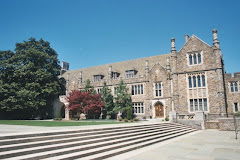
Our new website here at the Duke University Dept of Religion went live today. Let us know what you think:
Duke University Religion Departmemnt
Thursday, March 18, 2010


Monday, March 15, 2010
Between God and the Secular: The Future of Citizenship

Tuesday March 23 2010, 5.30pm
Room 0012 Westbrook, Divinity School
Peter Steinfels
Religion Columnist for the New York Times and Co-Director of the Fordham University Center on Religion and Culture
What does it mean for American public life and specifically for our politics to live in a post-secular world where neither religious faith nor secularization shows any signs of disappearing? To bar religious argument and appeals from our political debates would be both impossible and impoverishing. But for a pluralist, for a religiously diverse society to avoid intractable conflicts it needs a new ethic of "post-secular citizenship" involving both literacy and enlarged sensibilities on the part of believers and non-believers.
A two-time Pulitzer Prize nominee and former senior religion correspondent for the New York Times, Dr. Steinfels created and continues to pen his biweekly column "Beliefs," dealing with religion and ethics. His books includes A People Adrift: The Crisis of the Roman Catholic Church in America and The Neoconservatives, and he co-edited Death Inside Out. Dr Steinfels and his wife, Margaret O'Brien Steinfels, became the founding co-directors of the Fordham Center on Religion and Culture in 2004. The Center explores questions that arise when religious faith intersects with contemporary culture and fosters dialogue on the challenges posed to the culture.
The lecture is being sponsored by the Department of Religion, the Dennis and Rita Meyer Endowment Fund, Evelyn and Valfrid Palmer Roman Catholic Studies Endowment Fund, and the John-Kelly C. Warren Roman Catholic Studies Endowment Fund.
Tuesday, February 9, 2010
Q & A with Mohsen Kadivar
Today's Duke Chronicle has a Q & A with Mohsen Kadivar:
By Ciaran O'Connor
Mohsen Kadivar, a visiting professor in the religion department, spent 18 months in an Iranian prison for speaking his mind.
Kadivar, 50, who is teaching an undergraduate class and a seminar in the Divinity School, is a prominent Iranian cleric and political dissident. Most recently, along with four other leading opposition figures outside Iran, Kadivar drafted and signed an open letter calling for the resignation of Iranian President Mahmoud Ahmadinejad, free elections, the release of political prisoners, greater freedom of speech and an independent judiciary . . . .
Wednesday, February 3, 2010
Remembering Mary Daly

Remembering Mary Daly
A Reflection of Her Life and Work
Thursday February 18
5.00pm
0015 Westbrook Duke Divinity School
The reception is sponsored by the Dennis and Rita Meyer Endowment for Catholic Studies, Department of Religion, Duke University
A Reflection of Her Life and Work
Thursday February 18
5.00pm
0015 Westbrook Duke Divinity School
- Elizabeth Clark, Dept of Religion, Duke University
- Mary McClintock Fulkerson, Duke Divinity School
- Amy Laura Hall, Duke Divinity School
- Kathy Rudy, Women's Studies Program, Duke University
- Randall Styers, Dept of Religious Studies, UNC-Chapel Hill
- Reflections by Duke and UNC Graduate Students
The reception is sponsored by the Dennis and Rita Meyer Endowment for Catholic Studies, Department of Religion, Duke University
Friday, January 29, 2010
Follow us on Twitter
You can now follow Duke University Department of Religion on Twitter. Our twitter feed will feature news, events, announcements and it is a great way of keeping up to date with our activities:
Saturday, October 24, 2009
DukeEngage Returns to India's Pearl City, Hyderabad!

In its second year's run, The Loom & the Wheel: Literacy & Livelihood in Hyderabad will once again see Duke undergraduates in the Pearl City in the summer of 2010 (June 7- August 7) . The program, co-directed by Leela (Dept of Religion, Duke) and Prasad (Vivekin Group) is a collaboration with the Association for India’s Development and the Smile for Life
 Foundation. Like in 2008, we will work with elementary school children in economically underprivileged communities on communicative English and storytelling skills, basic science experiments, and visual-art and theater-art projects. The goal: to make the experience of education fun, fruitful, and far-reaching, even transformative, for everybody involved in this collaboration.
Hyderabad is a beautiful city, known to its historians and its fans as the city that materializes the cusp between Muslim and Hindu cultures. Although these are two prominent populations of Hyderabad, it is home to other religious communities like Sikhs, Christians and Parsis, for example. One of the fastest growing cities of India, Hyderabad has become a global technology site in which its new glass architecture
 now sits intriguingly amidst its magnificent 500-year old stone monuments.
Our DukeEngage team will explore these and other juxtapositions and intersections, the glories and the worries they produce, and discover the rhythms of Hyderabadi daily life, food, its world-famous pearls and bangles, and the arts.

For more details, see http://www.duke.edu/~leela/dukeengage/
To apply for this program, click here
Thursday, October 22, 2009
New Faculty Profile: Mona Hassan
 On Duke Today, you can read about one of our new faculty members, Mona Hassan, assistant professor of Islamic Studies and History in the Department of Religion:
Mona Hassan: The History of Emotions and Religious Imaginations
Religion professor explores how the Muslim past shapes imaginations of the future
By Andrea Fereshteh
Religion professor explores how the Muslim past shapes imaginations of the future
By Andrea Fereshteh
Subscribe to:
Posts (Atom)